Delta-One
Deception PointDelta-One is the disciplined field leader of a covert operation guarding the NASA installation on the Arctic ice. His arc shows how a mission presented as controlled and initially intended to avoid casualties becomes a succession of violent attempts to silence witnesses, ending in his own death when the armed Kiowa he pilots plunges into the sea.
Identity and Mission
Delta-One leads a three-man team stationed above the Eighty-second Parallel. The men shelter in a white ThermaTech storm tent set low and out of sight, equipped with advanced communications, transport, and weapons. Delta-One is described as muscular and lithe, with a severe bearing that reflects the bleak terrain around him. He has learned to suppress emotion in the service of assignments, treating orders as obligations rather than questions about purpose.
The team’s immediate task is surveillance, not combat. For ten days they have watched a large structure rise about a thousand meters away. Delta-One understands that the information inside it could change the world, and knows that people have already died to protect it. The contrast between the team’s concealed position and the conspicuous facility establishes the operation’s central tension: the watchers remain hidden while the knowledge they guard threatens to become public.
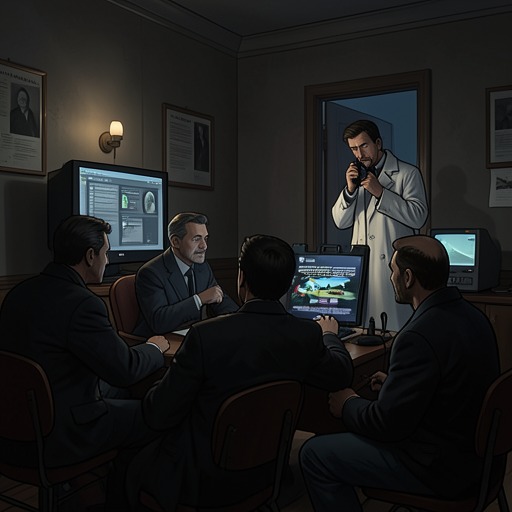
The operation is organized through a faceless briefing delivered over secure electronic channels. Delta-One has never met the controller, whose voice reaches him through the CrypTalk in a robotic, androgynous tone. This separation obscures who is exercising authority and leaves the field team with little knowledge of the operation’s larger design. When the controller reports that a new player has entered the situation, Delta-One receives no new rationale; the order is simply that the existing instructions stand.
Surveillance Turns to Violence
From his position a thousand meters up the glacier, Delta-One watches the administrator of NASA escort Rachel Sexton into the dome. Her arrival makes the surveillance mission more immediate, but it does not change the team’s instructions. Later, as the investigators begin to challenge the account of the meteorite, Delta-One remains close enough to hear that the situation has shifted from observation to exposure. In the darkness, only fifty yards away, he reports the change to the controller in two words: they know.
Delta-One’s conduct is governed by obedience rather than remorse. After he confronts a woman left unconscious on the ice, he feels no regret; his training has taught him to carry out orders, not judge their motives. This disposition gives the operation an impersonal quality, but it also makes its escalation possible: actions with grave consequences can be treated as execution of a command rather than decisions for which the operative accepts responsibility.
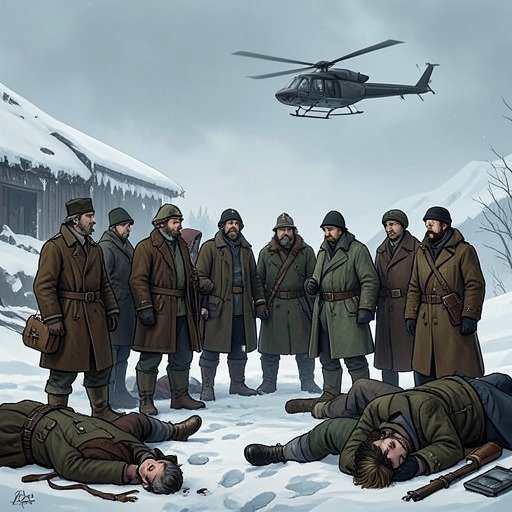
When Rachel and the others escape, Delta-One initially sees their survival as temporary. Their block of ice has begun separating from the shelf, with a widening crevasse between them and stable ground. He recognizes that the unstable ice could kill the fugitives without leaving bodies to be found, and considers allowing the breakaway to finish the job. He later tells his team that the other three have gone over the edge. The strategy reflects the operation’s movement toward concealment as much as elimination: the disappearance of the targets would also erase evidence of what happened to them.
Orders, Authority, and Escalation
The controller’s authority does not mean the operation remains within its original limits. Delta-One reports that unexpected events on the ice shelf left his team with no option but to use force, including killing four civilians, among them Rachel Sexton and Michael Tolland. The controller is shocked: lethal action had been permitted only as a last resort and had not been part of the plan. The controller’s anger becomes explicit upon learning that three of the four targets are still alive. The exchange exposes a widening gap between the mission as authorized and the violence actually carried out by its agents.
That gap also complicates the idea of a zero-casualty operation. During a later flight over the Labrador Sea, Delta-One receives a call from the controller and hears that a new individual is now a target. The identity is one he and his partners recognize, and the expanding target profile makes clear that the operation is no longer confined to the original witnesses. Delta-One tightens at the prospect of being told how and where this person is to be eliminated. The narrative presents him as an instrument of the chain of command, but not as unaware of its escalating stakes.
The larger political dispute over NASA provides the institutional backdrop to the operation. At a meeting of the National Security Council, officials consider bringing NASA into the military intelligence community. President Herney resists placing the agency under the Pentagon or an intelligence service, while Lawrence Ekstrom argues that NASA’s technologies are intended for nonmilitary scientific and academic uses. Delta-One’s covert assignment stands in sharp contrast to that public distinction between space science and national security: the operation treats control of NASA’s discovery as a matter of intelligence and political power, even as officials dispute whether NASA should be absorbed into that world.
The Goya and the Final Pursuit
The pursuit reaches the Goya with Delta-One piloting a Kiowa gunship. As the aircraft crosses northern Delaware, Delta-Two reports that the helicopter’s umbrella system is engaged, with its barrage, modulated noise, and cover pulse activated. Over the Goya, Delta-One sees an unexpected scene on deck. He judges Rachel and Michael Tolland to appear in control, but recognizes that the machine gun in Tolland’s hands is empty: its cocking bar indicates that the clip has run out.
Delta-One acts while attention on deck is fixed elsewhere. Leaving the helicopter’s rotors running, he uses the aircraft as cover, moves unseen onto the starboard gangway, and heads toward the bow with his weapon. His immediate aim is to carry out instructions he received from William Pickering before landing. He sees this as a task he must not fail, even as the situation around him becomes less controllable.
Later, Delta-One believes he can still close the trap. He considers freeing Delta-Two from the clamps and eliminating Rachel and Tolland. He points his weapon at Rachel from close range; Tolland’s clenched fists register his protective response. When Rachel moves toward the submarine hatch, Delta-One fires, but she drops through the opening beneath the bullets and the hatch cover closes after ricochets strike it. His attempt to stop her does not succeed.
As the Goya’s deck tilts, Delta-One scrambles toward the sliding helicopter and climbs into the cockpit. He takes the controls rather than let the team’s means of escape slide away. The heavily armed Kiowa, burdened with Hellfire warheads, struggles to lift; its forward-tilted blades drive it toward the Triton and Delta-Two rather than cleanly upward. The effort to regain control ends when the aircraft lists over the edge and plunges into the sea. Delta-One’s final action is not a successful escape or a completed attack, but the loss of the gunship and his own life amid the collapse of the operation.
Character and Narrative Function
Delta-One is defined less by a personal history than by his role within a concealed command structure. The faceless briefing, remote controller, coded communications, and repeated reliance on orders keep the reader at a distance from the people directing the operation. Delta-One embodies its field-level consequences: he watches, reports, pursues, and uses force, while the purpose and limits of the mission are determined elsewhere.
His arc is also a measure of how far the operation has departed from its stated design. The team begins as watchers, with an assignment initially framed as avoiding casualties; it ends in lethal pursuit, an enlarged list of targets, and the destruction of the helicopter. Delta-One’s lack of remorse does not make him an independent architect of the scheme, but neither does his obedience erase his actions. The distance between remote authorization and physical execution is the defining conflict of his role.